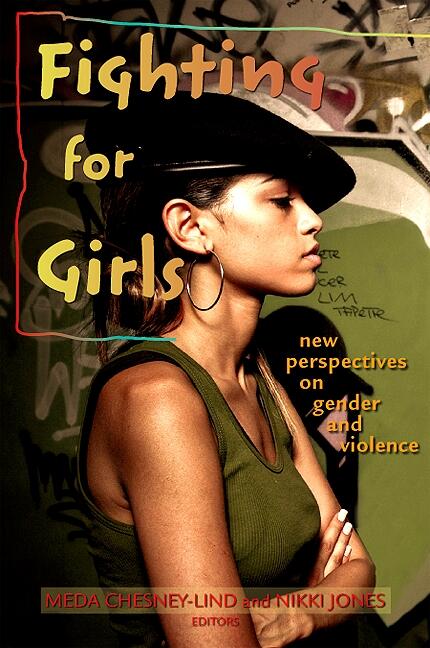
Fighting for Girls
New Perspectives on Gender and Violence
Alternative formats available from:
Cutting edge research into trends and social contexts of girls' violence.
Description
Have girls really gone wild? Despite the media fascination with "bad girls," facts beyond the hype have remained unclear. Fighting for Girls focuses on these facts, and using the best data availabe about actual trends in girls' uses of violence, the scholars here find that by virtually any measure available, incidents of girls' violence are going down, not up. Additionally, rather than attributing girls violence to personality or to girls becoming "more like boys," Fighting for Girls focuses on the contexts that produce violence in girls, demonstrating how addressing the unique problems that confront girls in dating relationships, families, school hallways and classrooms, and in distressed urban neighborhoods can help reduce girls' use of violence. Often including girls' own voices, contributors to the volume illustrate why girls use violence in certain situations, encouraging us to pay attention to trauma in the girls' pasts as well as how violence becomes a tool girls use to survive toxic families, deteriorated neighborhoods, and neglectful schools.
Meda Chesney-Lind is Professor of Women's Studies at the University of Hawaii at Manoa. Her many books include Beyond Bad Girls: Gender, Violence, and Hype (coauthored with Katherine Irwin); The Female Offender: Girls, Women, and Crime, Second Edition (coauthored with Lisa Pasko); and Girls, Delinquency, and Juvenile Justice, Third Edition (coauthored with Randall G. Shelden). Nikki Jones is Assistant Professor of Sociology at the University of California, Santa Barbara. She is the author of Between Good and Ghetto: African American Girls and Inner City Violence.
Reviews
"Fighting for Girls represents a much-needed antidote to the epidemic of depictions of girls as violent offenders threatening the fabric of contemporary society … in one volume, readers are presented with not only ten new investigations but also with discussions of findings from hundreds of other studies all pointing to the same conclusion: girls simply are not more violent than in past … Informed by feminist perspectives and contemporary research and theory in psychology, sociology and criminal justice, readers searching for information regarding the truth about the stereotypes of violent girls will not find a better, broader, or more in depth discussion of this issue than in Fighting for Girls." — Journal of Youth and Adolescence
"…a fresh, much needed look at violence among young (adolescent) girls. Chesney-Lind and Jones have assembled quite a volume; its ten chapters cover an enormous range … Highly recommended." — CHOICE
"From a broad range of perspectives and empirical studies, this book addresses a number of important questions central to the study of girls and violence." — Sara Goodkind, University of Pittsburgh