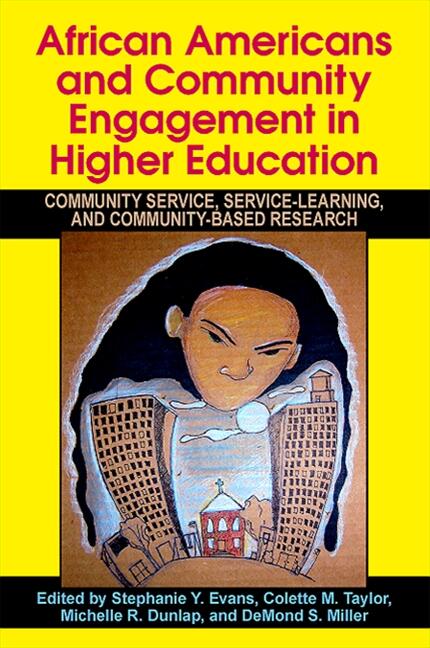
African Americans and Community Engagement in Higher Education Community Service, Service-Learning, and Community-Based Research
Click on image to enlarge
Stephanie Y. Evans - Editor Colette M. Taylor - Editor Michelle R. Dunlap - Editor DeMond S. Miller - Editor
Price: $75.00 Hardcover - 285 pages
Release Date: September 2009
ISBN10: N/A ISBN13: 978-1-4384-2873-4
Price: $24.95 Paperback - 285 pages
Release Date: September 2009
ISBN10: N/A ISBN13: 978-1-4384-2874-1
Available as a Google eBook, for other eReaders and tablet devices, Click below...
Google eBookNew!
Summary
Looks at town-grown relationships with a focus on African Americans.
This book discusses race and its roles in university-community partnerships. The contributors take a collaborative, interdisciplinary, and multiregional approach that allows students, agency staff, community constituents, faculty, and campus administrators an opportunity to reflect on and redefine what impact African American identity—in the academy and in the community—has on various forms of community engagement. From historic concepts of “race uplift” to contemporary debates about racialized perceptions of need, they argue that African American identity plays a significant role. In representing best practices, recommendations, personal insight, and informed warnings about building sustainable and mutually beneficial relationships, the contributors provide a cogent platform from which to encourage the difficult and much-needed inclusion of race in dialogues of national service and community engagement.
“[African Americans and Community Engagement in Higher Education’s] balance of theory and practice, as well as historical and contemporary contexts, can provide tools for achieving cultural competency in community service in any discipline, through informing the transition from ‘doing’ to ‘being’ community service.” — Teaching Theology and Religion
“This book validates the African proverb ‘it takes a village to raise a child.’ The topics are right on the mark and highlight the benefits of service-learning as an instrument of individual and community involvement and empowerment.” — Festus E. Obiakor, coeditor of Culturally Responsive Literacy Instruction
Stephanie Y. Evans is Associate Professor of African American Studies and Women’s Studies at the University of Florida and the author of Black Women in the Ivory Tower, 1850–1954: An Intellectual History. Colette M. Taylor is Assistant Professor of Higher Education at Texas Tech University. Michelle R. Dunlap is Professor and Chair of Human Development at Connecticut College and the author of Reaching Out to Children and Families: Students Model Effective Community Service. DeMond S. Miller is Professor of Sociology at Rowan University and the coauthor (with Jason David Rivera) of Hurricane Katrina and the Redefinition of Landscape.
Table of Contents
List of Tables
Preface: Using History, Experience, and Theory to Balance
Relationships in Community Engagement Stephanie Y. Evans
Acknowledgments
Introduction: Characteristics of Engagement: Communicated
Experiences of Race, Universities, and Communities Colette M. Taylor
Part 1. Community Service, Volunteerism, and
Engagement Stephanie Y. Evans, Colette M. Taylor,
Michelle R. Dunlap, and DeMond S. Miller
1. The Community Folk Art Center: A University and Community
Creative Collaboration Kheli R. Willetts
2. An African American Health Care Experience: An Academic
Medical Center and Its Interdisciplinary Practice Kendall M. Campbell
3. African American College Students and Volunteerism:
Attitudes toward Mentoring at a Title I School Joi Nathan
4. Prejudice, Pitfalls, and Promise: Experiences in Community
Service in a Historically Black University Jeff Brooks
Part 2. Community Service-Learning Michelle R. Dunlap
5. Can the Village Educate the Prospective Teacher?:
Reflections on Multicultural Service-Learning in African
American Communities Lucy Mule
6. Sowing Seeds of Success: Gardening as a Method of Increasing Academic Self-Efficacy and Retention among
African American Students
August Hoffman, Julie Wallach, Eduardo Sanchez, and
Richard Carifo
7. A Service or a Commitment?: A Black Man Teaching
Service-Learning at a Predominantly White Institution Troy Harden
8. Racial Identity and the Ethics of Service-Learning as Pedagogy Annemarie Vaccaro
9. “We’ll Understand It Better By and By”: A Three-Dimensional
Approach to Teaching Race through Community Engagement Meta Mendel-Reyes and Dwayne A. Mack
Part 3. Community-Based Research DeMond S. Miller
10. Black Like Me: Navigating Race, Gender, Research, and
Community
Fleda Mask Jackson
11. A Partnership with the African American Church: IMPPACT
and S.P.I.C.E.S. For Life
Micah McCreary, Monica Jones, Raymond Tademy, and John Fife
12. “I Have Three Strikes Against Me”: Narratives of Plight and
Efficacy among Older African American Homeless Women
and Their Implications for Engaged Inquiry Olivia G. M. Washington and David P. Moxley
13. A Culturally Competent Community-Based Research
Approach with African American Neighborhoods: Critical
Components and Examples Richard Briscoe, Harold R. Keller, Gwen McClain,
Evangeline R. Best, and Jessica Mazza
14. Community Engagement and Collaborations in Community-Based
Research: The Road to Project Butterfly GiShawn Mance, Bernadette Sánchez, and Niambi Jaha-Echols
Final Word: African Americans and Community Engagement:
A Challenge and Opportunity for Higher Education Donald F. Blake