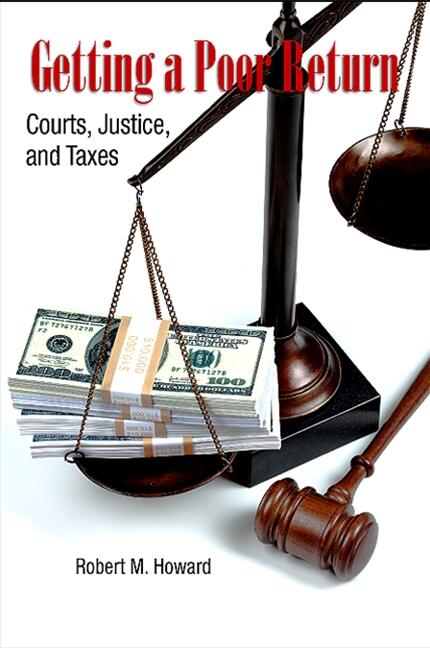
Getting a Poor Return
Courts, Justice, and Taxes
Alternative formats available from:
Examines competing claims and beliefs about the American legal system in the area of tax policy and tax enforcement.
Description
Public policy often favors one group over another. In the case of tax policy, the conventional wisdom has been that the dominant political coalition will offer policies that favor their primary constituents. The longstanding belief has been that the disfavored group may always assert their rights in court, the expectation being, as Justice John Marshall Harlan wrote, that "all citizens are equal before the law." In this revealing and insightful study, Robert M. Howard demonstrates that long-cherished beliefs such as equality before the law are more wishful thinking than reality. Courts, he argues, differ little from national policy makers in their approach to tax policy and tax enforcement. Examining the tax litigation process, particularly the influence and impact of competing courts, Howard discovers that fairness before the law may be a laudable goal, but the appointment process ensures that tax policy and tax enforcement rulings by the courts reflect the perspectives of the dominant political coalition.
Robert M. Howard is Associate Professor of Political Science at Georgia State University.
Reviews
"…Howard provides a most insightful examination of how U.S. tax policy is shaped by the U.S. District Court and the more specialized U.S. Tax Court … this book has implications far beyond tax policy. Most impressively, it investigates why litigants choose to file their tax suits in particular venues, as well as how those courts render their decisions. In so doing, it advances our understanding of two of the most significant aspects of the study of law and courts: litigation strategies and judicial decision making." — American Review of Politics
"The book fits nicely at the intersection of several well-developed and important literatures, including judicial decision-making, litigant choice, 'upperdogs versus underdogs,' bureaucratic discretion, and congressional-executive relations … the emphasis on the low-income litigant's plight is a powerful way of contextualizing the larger study and accentuating why such an inquiry is so important." — Law and Politics Book Review