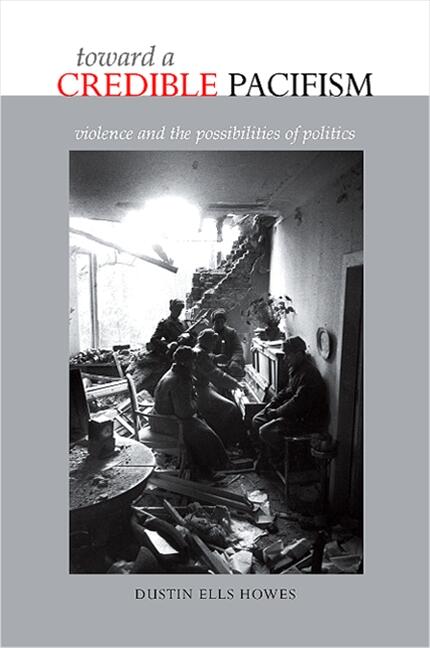
Toward a Credible Pacifism
Violence and the Possibilities of Politics
Alternative formats available from:
Argues that violence is no more reliable than any other means of conducting politics.
Description
Advocates of pacifism usually stake their position on the moral superiority of nonviolence and have generally been reluctant or unwilling to concede that violence can be an effective means of conducting politics. In this compelling new work, which draws its examples from both everyday experience and the history of Western political thought, author Dustin Ells Howes presents a challenging argument that violence can be an effective and even just form of power in politics. Contrary to its proponents, however, Howes argues that violence is no more reliable than any other means of exercising power. Because of this there is almost always a more responsible alternative. He distinguishes between violent and nonviolent power and demonstrates how the latter can confront physical violence and counter its claims. This brand of pacifism gives up claims to moral superiority but recuperates a political ethic that encourages thoughtfulness about suffering and taking responsibility for our actions.
Dustin Ells Howes is Assistant Professor of Political Science at Louisiana State University.
Reviews
"One need not be an avid reader of Gandhi or Martin Luther King or even a political theorist to recognize the value of a book that rethinks both the power and effectiveness of violence and nonviolence … this volume goes a long way toward illuminating the political possibilities of a credible pacifism. " — Perspectives on Politics
"…sheds a bright light on the amount of power it takes to support and maintain violence … Furthermore, this book advances the conversation between advocates of nonviolence and its detractors in important ways … Toward a Credible Pacifism makes a convincing case for credibly reintroducing the study of nonviolence into the security studies and political theory agendas. " — Peace Review
"Dustin Ells Howes' book is … important and groundbreaking … Howes has brilliantly achieved the promise of his subtitle. Against all expectations, he has stabilized the concept of human violence by establishing the causal link between its physical and intersubjective manifestations. Next, and perhaps more important, he has clarified the relationship between human 'violence and the possibilities of politics' by clarifying the relationship between human violence and sociopolitical power. It is a stunning achievement. " — Journal of Religion, Conflict, and Peace
"…those interested in the nature and purposes of violence in politics will find much to admire in this wide-ranging and subtle work … [Howes'] treatment of freedom, power, and causes and responses to human suffering illustrate the complexities of violence in the contemporary world. " — CHOICE