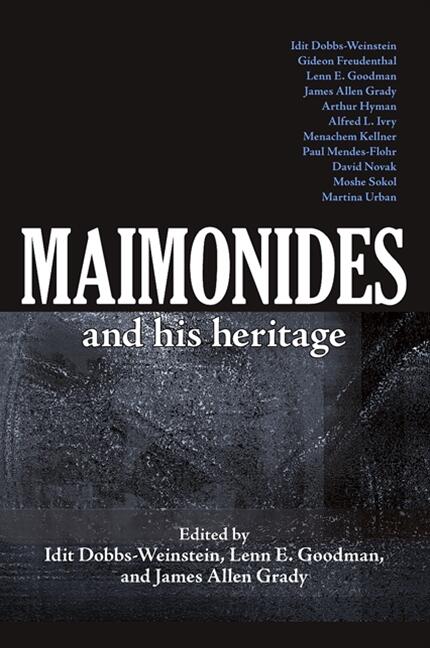
Maimonides and His Heritage
Alternative formats available from:
Examines the Jewish philosopher’s influence on theology, philosophy, medicine, and law, and his impact on later thinkers.
Description
This volume celebrates the depth and breadth of Jewish philosopher Moses Maimonides' (1138–1204) achievements. The essays gathered here explore the rich diversity of a heritage that extends over eight hundred years, beginning with Maimonides' historical context; ranging through his distinct contributions to philosophy, theology, medicine, and Jewish law; to the impact his ideas have had on later generations. His humane perspective and commitment to intellectual rigor are reflected in the wide range of his works and his active role as a spiritual guide and intellectual leader. Maimonides' intellectual openness makes his work an enduring model of creative synthesis and critical appropriation, as well as a continuing source of intellectual stimulation not only for the many specialist scholars who scrutinize his texts but also for a wide and lively audience of nonspecialists.
Idit Dobbs-Weinstein is Associate Professor of Philosophy at Vanderbilt University and the author of Maimonides and St. Thomas on the Limits of Reason, also published by SUNY Press. Lenn E. Goodman is Professor of Philosophy and Andrew W. Mellon Professor in the Humanities at Vanderbilt University. He is the author or editor of many books, including Aristotle's Politics Today (coedited with Robert B. Talisse); Jewish Themes in Spinoza's Philosophy (coedited with Heidi M. Ravven); and Neoplatonism and Jewish Thought, all published by SUNY Press. James Allen Grady is a PhD candidate in Philosophy and Graduate Fellow at the Center for the Study of Religion and Culture at Vanderbilt University.
Reviews
"…an important contribution to the understanding and appreciation of Maimonides … This volume is also an eclectic mix of themes and scholarship." — Jewish Book World
"The third section of the volume, on Maimonides in recent times, sets this apart from the many other books on the great man who died in 1204." — Association of Jewish Libraries Newsletter