top_1_963_35.JPG
top_2_1.jpg top_2_2.jpg
 
 
  HOME   PUBLISH   DONATE   ABOUT   CONTACT   HELP   SEARCH  
 
   
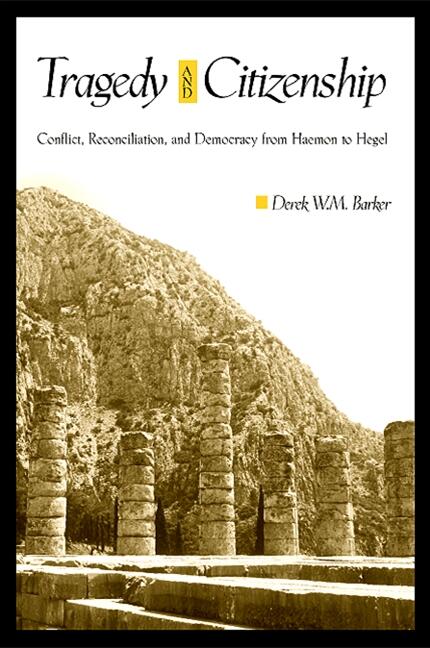
Tragedy and Citizenship
Conflict, Reconciliation, and Democracy from Haemon to Hegel
Tragedy and Citizenship
Click on image to enlarge

Derek W. M. Barker - Author
Price: $60.00 
Hardcover - 198 pages
Release Date: November 2008
ISBN10: N/A
ISBN13: 978-0-7914-7629-1

Quantity:  
Price: $23.95 
Paperback - 198 pages
Release Date: July 2009
ISBN10: N/A
ISBN13: 978-0-7914-7630-7

Quantity:  
Price: $23.95 
Electronic - 198 pages
Release Date: November 2008
ISBN10: N/A
ISBN13: 978-0-7914-7740-3


**Requires Adobe PDF Reader
Available as a Google eBook,
for other eReaders and tablet devices,
Click below...

Google eBookNew!

Summary Read First Chapter image missing

A study of attitudes toward tragedy in both democratic and nondemocratic political theory.

Tragedy and Citizenship provides a wide-ranging exploration of attitudes toward tragedy and their implications for politics. Derek W. M. Barker reads the history of political thought as a contest between the tragic view of politics that accepts conflict and uncertainty, and an optimistic perspective that sees conflict as self-dissolving. Drawing on Aristotle’s political thought, alongside a novel reading of the Antigone that centers on Haemon, its most neglected character, Barker provides contemporary democratic theory with a theory of tragedy. He sees Hegel’s philosophy of reconciliation as a critical turning point that results in the elimination of citizenship. By linking Hegel’s failure to address the tragic dimensions of politics to Richard Rorty, John Rawls, and Judith Butler, Barkeroffers a major reassessment of contemporary political theory and a fresh perspective on the most urgent challenges facing democratic politics.

“In Tragedy and Citizenship, Derek Barker undertakes a wide-ranging journey in political theory from ancient Greek theatre to contemporary American postmodernism. He takes seriously the view that tragedy (i.e., conflict, suffering, imperfect knowledge) is an integral part of the human condition that requires some kind of response.” — Polis

“In this engaging, insightful study, Barker argues that tragic drama in democratic Athens sought to teach citizens about the inevitability of conflict and the danger of flawed responses to it.” — CHOICE

Derek W. M. Barker is a program officer at the Kettering Foundation.


Bookmark and Share

Table of Contents

Acknowledgments
Introduction: Conflict, Reconciliation, and Citizenship

1. Listening to Haemon: Citizenship in the Antigone

2. Pity, Fear, and Citizenship: The Politics of Aristotle’s Poetics

3. Hegel and the Politics of Reconciliation

4. Redescription as Reconciliation: Richard Rorty

5. John Rawls and Hegelian Political Philosophy

6. Judith Butler’s Postmodern Antigone

Conclusion: Tragedy, Citizenship, and the Human Condition

Notes
Bibliography
Index


Related Subjects
47543/47544(MR/KW/MC)

Related Products

JFK, LBJ, and the Democratic Party
Globalization, Security, and the Nation State
Governing New York State
Executing the Constitution
North Korea under Kim Jong Il


Customers Who Bought This Product Also Bought
Philosophy and the City
       
 
bottom_1_963_35.jpg