Available as a Google eBook, for other eReaders and tablet devices, Click below...
Google eBookNew!
Summary
Examines the early works of German-Jewish political philosopher Leo Strauss (1899–1973).
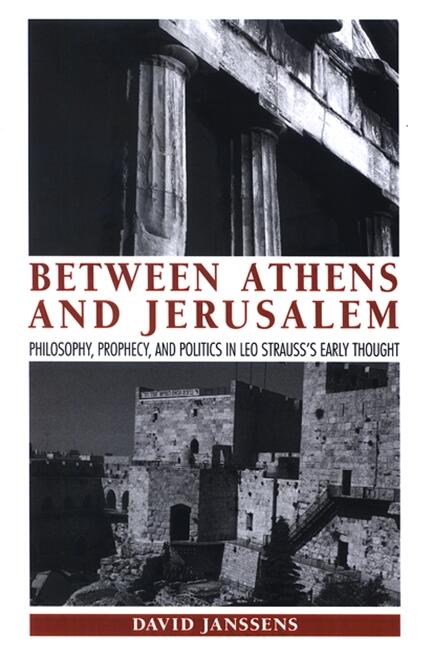
Praised as a major political thinker of the twentieth century and vilified as the putative godfather of contemporary neoconservatism, Leo Strauss (1899–1973) has been the object of heated controversy both in the United States and abroad. This book offers a more balanced appraisal by focusing on Strauss’s early writings. By means of a close and comprehensive study of these texts, David Janssens reconstructs the genesis of Strauss’s thought from its earliest beginnings until his emigration to the United States in 1937. He discusses the first stages in Strauss’s grappling with the “theological-political problem,” from his doctoral dissertation on Friedrich Heinrich Jacobi to his contributions to Zionist periodicals, from his groundbreaking study of Spinoza’s critique of religion to his research on Moses Mendelssohn, and from his rediscovery of medieval Jewish and Islamic philosophy to his research on Hobbes. Throughout, Janssens traces Strauss’s rediscovery of the Socratic way of life as a viable alternative to both modern philosophy and revealed religion.
“…the best attempt to date to make sense of the early Strauss and trace the development of his thought on the relation between religion, politics, and philosophy.” — Review of Politics
“In revising and enlarging a book that was originally written and published in Dutch for Europeans, the author has done a good job of addressing himself and his account to Americans. This is a major and serious scholarly contribution to the vibrant ongoing study and interpretation of Strauss’s thought. It adds a whole new dimension to the discussion of Strauss and will greatly deepen and broaden the understanding of him in the English-speaking world.” — Thomas L. Pangle, author of Leo Strauss: An Introduction to His Thought and Intellectual Legacy
“An extremely helpful introduction to the major themes of Strauss’s thought for both students and scholars, as well as a compelling demonstration of the light his early European work sheds on the themes of his more familiar American work.” — Nathan Tarcov, author of Locke’s Education for Liberty
David Janssens is Assistant Professor of Philosophy of Law at Tilburg University in The Netherlands.
Table of Contents
List of Abbreviations
Leo Strauss’s Early Years: Chronology of Major Events and Writings (1899–1937)
Introduction
1. “In the Grip of the Theological-Political Predicament”
The Theological-Political Problem and the Jewish Question
Back to Reality: Emancipation, Assimilation, and Zionism
“God and Politics”
Biblical Politics, Biblical Science, and the New Theology
Quaestio Iuris: The Legacy of Spinoza
2. The Shadow of Spinoza
“A Humanly Incomprehensible Betrayal”
Before the Tribunal: Biblical Science and the Critique of Religion
Spinoza’s Twofold Strategy
Maimonides: The Limits of Reason and the Interest in Revelation
Calvin: “Like Clay in the Potter’s Hand”
Happiness and Ridicule: The Epicurean Connection
Farewell to Spinoza
3. The Second Cave
The Crisis of the Enlightenment: Jacobi, Mendelssohn, and the Pantheism Controversy
Atheism, Intellectual Probity, and the Love of Truth
The Socratic Question and the Fate of Philosophy
4. The Order of Human Things
Medieval Enlightenment: Nomos and Platonic Politics
Between the Lines: The Art of Writing
“A Horizon Beyond Liberalism”: The Debate with Carl Schmitt
5. Socrates and the Leviathan
Hobbes’s Motive
“The Right Order of Society”
Fighting the Kingdom of Darkness
6. Epilogue
The Surface and the Core
The Problem of Socrates
Machiavelli’s Oblivion
Natural Right and the Socratic Question
From Jerusalem to Athens (and Back)