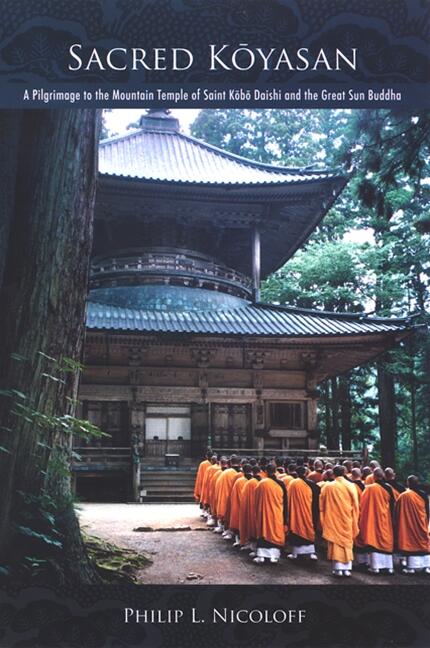
Sacred Kōyasan
A Pilgrimage to the Mountain Temple of Saint Kōbō Daishi and the Great Sun Buddha
Alternative formats available from:
Takes the reader on a pilgrimage to Mount Kōya, the holy Buddhist mountain in Japan.
Description
For more than one thousand years, the vast Buddhist monastery and temple complex on remote Mount Kōya has been one of Japan's most important religious centers. Saint Kōbō Daishi (also known as Kūkai), founder of the esoteric Shingon school and one of the great figures of world Buddhism, consecrated the mountain for holy purposes in the early 800s. Buried on Kōyasan, Kōbō Daishi is said to be still alive, selflessly advocating for the salvation of all sentient beings.
Located south of Osaka, Kōyasan has attracted visitors from every station of Japanese life, and in recent years, more than a million tourists and pilgrims visit annually. In Sacred Kōyasan, the first book-length study in English of this holy Buddhist mountain, Philip L. Nicoloff invites readers to accompany him on a pilgrimage. Together with the author, the pilgrim-reader ascends the mountain, stays at a temple monastery, and explores Kōyasan's main buildings, sacred statues, and famous forest cemetery. Author and reader participate in the full annual cycle of rituals and ceremonies, and explore the life and legend of Kōbō Daishi and the history of the mountain.
Written for both the scholarly and general reader, Sacred Kōyasan will appeal to potential travelers, dedicated armchair travelers, and all readers interested in Buddhism and Japanese culture.
Philip L. Nicoloff is Professor Emeritus of English at the University of New Hampshire.
Reviews
"For those who have been to the mountain, the contents of this book should bring memories streaming back, and also illuminate sites on the mountain whose meanings otherwise may have been obscure. For those planning to go to the mountain, this book offers an extraordinary way to prepare. " — Journal of Asian Studies
"The wide-lensed approach employed by the author makes this general study a useful introduction for students embarking upon studies of Japanese religions, but it would best be used as a companion to more in-depth studies … There is much new material here for scholars to build upon. It will no doubt be a catalyst that will inspire further studies on this fascinating site and particularly, one hopes, on the contemporary aspects which Nicoloff brings to light. " — Eastern Buddhist
"Nicoloff … writes extremely well, and his descriptions of the location and of his experiences there make for vibrant and compelling reading … immensely enjoyable … a very useful and finely-crafted description of what one sees and what goes on at a major Buddhist center. "— Japanese Journal of Religious Studies
"…a capable piece of scholarship, referencing academic studies of Koyasan, Kukai, and Shingon. Yet the descriptions of the landscape and ritual activity, and even the lengthy section on the history of the place, are so beautifully written that it reads more like a fine piece of travel writing. This is Buddhism as a living—and lived—phenomenon, and a welcome reminder that Buddhism remains a vibrant presence in Japanese society. " — Buddhadharma
"This is a well-rounded historical and contemporary account of one of the most important sacred sites in Japan. The author opens up a significant area of inquiry for those studying Buddhism and Japanese culture, and integrates the personal dimension with the historical materials in a fascinating and compelling way. " — Steven Heine, author of Dōgen and the Kōan Tradition: A Tale of Two Shōbōgenzō Texts