|
Offers a sustained analysis of both high and low queer culture and its connections to cultural and political processes in Spain.
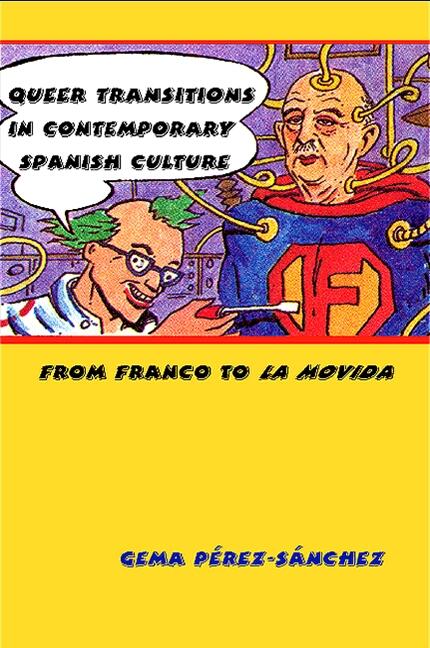
Gema Pérez-Sánchez argues that the process of political and cultural transition from dictatorship to democracy in Spain can be read allegorically as a shift from a dictatorship that followed a self-loathing “homosexual” model to a democracy that identified as a pluralized “queer” body. Focusing on the urban cultural phenomenon of la movida, she offers a sustained analysis of high queer culture, as represented by novels, along with an examination of low queer culture, as represented by comic books and films. Pérez-Sánchez shows that urban queer culture played a defining role in the cultural and political processes that helped to move Spain from a premodern, fascist military dictatorship to a late-capitalist, parliamentary democracy.
The book highlights the contributions of women writers Ana María Moix and Cristina Peri Rossi, as well as comic book artists Ana Juan, Victoria Martos, Ana Miralles, and Asun Balzola. Its attention to women’s cultural production functions as a counterpoint to its analysis of the works of such male writers as Juan Goytisolo and Eduardo Mendicutti, comic book artists Nazario, Rubén, and Luis Pérez Ortiz, and filmmaker Pedro Almodóvar.
“…an excellent academic study and a model for queer cultural scholarship in Hispanic studies.” — Hispania
“…an important and timely addition to the growing field of queer studies in modern Peninsular Spanish culture … Pérez-Sánchez’s analysis is driven by an impressive command of a very wide range of contemporary critical sources, combining Marxist-influenced cultural studies approaches with psychoanalytically inclined queer and feminist approaches … [Her] book is impeccably researched and very scholarly, paying as much attention to Anglo-American critical sources as to those coming from peninsular Spain.” — Hispanic Review
“The topic is significant because still today much remains to be done in mapping the contributions of lesbians, gays, bisexuals, and transgendered peoples to the Spanish cultural landscape. By giving priority to the study of women authors and sequential artists dealing with lesbianism, Queer Transitions in Contemporary Spanish Culture boldly and accurately situates itself within leading studies of sexualities.” — Silvia Bermúdez, coeditor of From Stateless Nations to Postnational Spain
Gema Pérez-Sánchez is Associate Professor of Spanish at the University of Miami.
|
Table of Contents List of Illustrations
Acknowledgments
Introduction
1. Franco’s Spain and the Self-Loathing Homosexual Model
2. Reading, Writing, and the Love That Dares Not Speak Its Name: Eloquent Silences in Ana María Moix’s Julia
3. From Castrating Fascist Mother-Nation to Cross-Dressed Late-Capitalist Democracy: Eduardo Mendicutti’s Una mala noche la tiene cualquiera
4. A Voyage in Feminist Pedagogy: Citationality in Cristina Peri Rossi’s La nave de los locos
5. Drawing Difference: The Cultural Renovations of the 1980s
Conclusion
Notes
Works Cited
Index
|