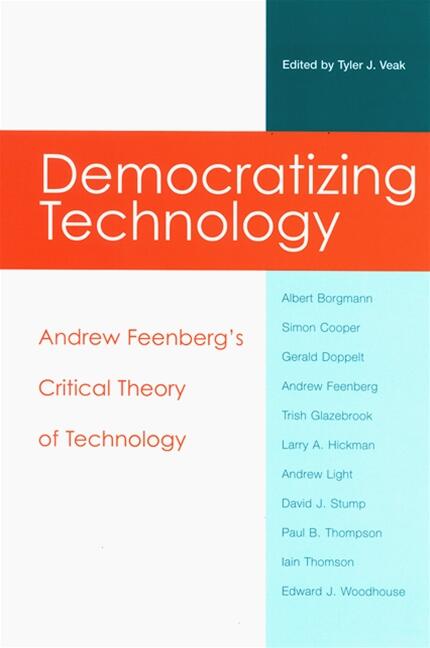
Democratizing Technology Andrew Feenberg's Critical Theory of Technology
Click on image to enlarge
Tyler J. Veak - Editor
Price: $83.50 Hardcover - 254 pages
Release Date: October 2006
ISBN10: 0-7914-6917-4 ISBN13: 978-0-7914-6917-0
Price: $31.95 Paperback - 254 pages
Release Date: October 2006
ISBN10: 0-7914-6918-2 ISBN13: 978-0-7914-6918-7
Price: $31.95 Electronic - 254 pages
Release Date: February 2012
ISBN10: N/A ISBN13: 978-0-7914-8096-0
Before purchasing a SUNY Press PDF eBook
for the first time you must read this...
click here
Also available as a Google eBook, for other eReaders and tablet devices, Click icon below...
Google eBookNew!
Also available on Kno platform as an interactive eBook for use on iPad, Web and Android devices.
Click icon below...
Summary
The first volume to critically engage the work of Andrew Feenberg.
Largely because of the Internet and the new economy, technology has become the buzzword of our culture. But what is it, and how does it affect our lives? More importantly, can we control and shape it, or does it control us? In short, can we make technology more democratic? Using the work of Andrew Feenberg, one of the most important and original figures in the field of philosophy of technology, as a foundation, the contributors to this volume explore these important questions and Feenberg responds.
In the 1990s, Feenberg authored three books that established him as one of the leading scholars in a rapidly developing field, and he is one of the few to delineate a theory for democratizing technological design. He has demonstrated the shortcomings of traditional theories of technology and argued for what he calls “democratic rationalization” where actors intervene in the technological design process to shape it toward their own ends. In this book, the contributors analyze foundational issues in Feenberg’s work, including questions of human nature, biotechnology, gender, and his readings of Heidegger, and they also examine practical issues, including democratizing technology, moral evaluation, and environmentalism.
“The subject of this volume is very important. Feenberg’s work deserves attention, as does the question about democratization of technology. The contributors not only reveal hidden dimensions in Feenberg’s work, but also make interesting contributions to broader discussions in philosophy of technology and critical theory. I particularly liked the response by Feenberg.” — David M. Kaplan, editor of Readings in the Philosophy of Technology
Contributors include Albert Borgmann, Simon Cooper, Gerald Doppelt, Andrew Feenberg, Trish Glazebrook, Larry A. Hickman, Andrew Light, David J. Stump, Paul B. Thompson, Iain Thomson, Tyler J. Veak, and Edward J. Woodhouse.
Tyler J. Veak is an Instruction Librarian at Liberty University. He received his Ph.D. in Science and Technology Studies at Virginia Tech.
Table of Contents
Acknowledgments
Introduction
PART 1: THEORETICAL ASSUMPTIONS OF A CRITICAL THEORY OF TECHNOLOGY
1. Rethinking Modernity as the Construction of Technological Systems David J. Stump
2. The Posthuman Challenge to Andrew Feenberg Simon Cooper
3. An Ecofeminist Response Trish Glazebrook
4. What’s Wrong with Being a Technological Essentialist? A Response to Feenberg Iain Thomson
5. From Critical Theory to Pragmatism: Feenberg’s Progress Larry A. Hickman
PART 2: THE POLITICS OF TECHNOLOGICAL TRANSFORMATION
6. Democracy and Technology Gerald Doppelt
7. Feenberg and the Reform of Technology Albert Borgmann
8. Commodification and Secondary Rationalization Paul B. Thompson
9. Democratic Technology, Population, and Environmental Change Andrew Light
10. Technological Malleability and the
Social Reconstruction of Technologies Edward J. Woodhouse