top_1_963_35.JPG
top_2_1.jpg top_2_2.jpg
 
 
  HOME   PUBLISH   DONATE   ABOUT   CONTACT   HELP   SEARCH  
 
   
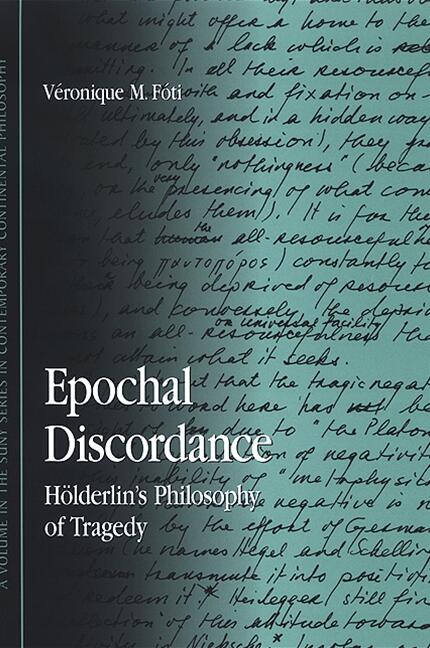
Epochal Discordance
Holderlin's Philosophy of Tragedy
Epochal Discordance
Click on image to enlarge

Veronique M. Foti - Author
SUNY series in Contemporary Continental Philosophy
Price: $55.00 
Hardcover - 155 pages
Release Date: September 2006
ISBN10: 0-7914-6859-3
ISBN13: 978-0-7914-6859-3

Quantity:  
Price: $24.95 
Paperback - 155 pages
Release Date: June 2007
ISBN10: N/A
ISBN13: 978-0-7914-6860-9

Quantity:  
Price: $24.95 
Electronic - 155 pages
Release Date: February 2012
ISBN10: N/A
ISBN13: 978-0-7914-8118-9

Before purchasing a SUNY Press PDF eBook
for the first time you must read this...

click here
Also available as a Google eBook,
for other eReaders and tablet devices,
Click icon below...

Google eBookNew!
Also available on Kno platform as an interactive eBook for use on iPad, Web and Android devices. Click icon below...


Summary Read First Chapter image missing

Examines the German poet Hölderlin’s philosophical insights into tragedy.

Friedrich Hölderlin must be considered not only a significant poet but also a philosophically important thinker within German Idealism. In both capacities, he was crucially preoccupied with the question of tragedy, yet, surprisingly, this book is the first in English to explore fully his philosophy of tragedy. Focusing on the thought of Hegel, Nietzsche, Heidegger, and Reiner Schürmann, Véronique M. Fóti discusses the tragic turning in German philosophy that began at the close of the eighteenth century to provide a historical and philosophical context for an engagement with Hölderlin. She goes on to examine the three fragmentary versions of Hölderlin’s own tragedy, The Death of Empedocles, together with related essays, and his interpretation of Sophoclean tragedy. Fóti also addresses the relationship of his character Empedocles to the pre-Socratic philosopher and concludes by examining Heidegger’s dialogue with Hölderlin concerning tragedy and the tragic.

“Original, interesting, and carefully argued, this book makes an important contribution by demonstrating that Hölderlin must be taken seriously for his work in philosophy. Among its numerous strengths, Fóti’s study contextualizes Hölderlin’s philosophy of tragedy within larger currents of post-Kantian continental philosophy, recognizes that Hölderlin’s overall approach to tragedy appears not as a rigid position, but rather emerges through a number of transformations in the course of his productive life, and sheds new light on several celebrated texts by Hölderlin, such as his ‘Remarks on Oedipus’ and ‘Remarks on Antigone.’” — Theodore D. George, author of Tragedies of Spirit: Tracing Finitude in Hegel’s Phenomenology

Véronique M. Fóti is Professor of Philosophy at Penn State at University Park and the author of Vision’s Invisibles: Philosophical Explorations, also published by SUNY Press, and Heidegger and the Poets: Poiesis/Sophia/Techne.


Bookmark and Share

Table of Contents

Prefatory Note
Prologue

1. The Tragic Turning and Tragic Paradigm in Philosophy

2. Communing with the Pure Elements: The First Two Versions of The Death of Empedocles

3. Singularity and Reconciliation: The Third Version of The Death of Empedocles

4. Between Hölderlin’s Empedocles and Empedocles of Akragas

5. The Faithless Turning: Hölderlin’s Reading of Oedipus Tyrannos

6. Dys-Limitation and the “Patriotic Turning”: Sophocles’s Antigone

7. From an Agonistic of Powers to a Homecoming: Heidegger, Hölderlin, and Sophocles

Epilogue
Notes
Bibliography
Index of Persons 
Index of Topics


Related Subjects
45196/45197(JFB/LDS/AV)

Related Products

Art and Its Significance
Being and Time
Being and Time
Human Experience
Human Experience
The Moral Warrior
The Moral Warrior
The Impact of the Internet on Our Moral Lives


Customers Who Bought This Product Also Bought
Figuring the Self
Figuring the Self
Hegel and Aesthetics
The Modern Subject
The Modern Subject
Sex and Gender in Medieval and Renaissance Texts
Idealism without Absolutes
 
bottom_1_963_35.jpg