Before purchasing a SUNY Press PDF eBook
for the first time you must read this...
click here
Also available as a Google eBook, for other eReaders and tablet devices, Click icon below...
Google eBookNew!
Also available on Kno platform as an interactive eBook for use on iPad, Web and Android devices.
Click icon below...
Summary
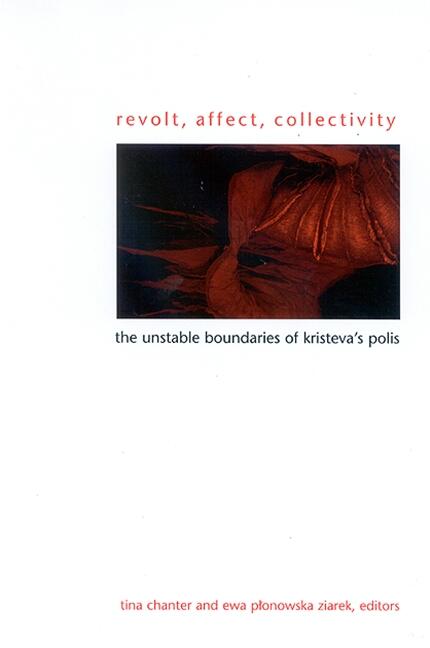
Explores how the concept of revolution permeates and unifies Kristeva’s body of work.
These original essays explore how the concept of revolution permeates and unifies Julia Kristeva’s body of work by tracing its trajectory from her early engagement with the Tel Quel group, through her preoccupation in the 1980s with abjection, melancholia, and love, to her latest work. Some of the leading voices in Kristeva scholarship examine her reevaluation of the concept of revolt in the context of the changing cultural and political conditions in the West; the questions of the stranger, race, and nation; her reflections on narrative, public spaces, and collectivity in the context of her engagement with Hannah Arendt’s work; her development and refinement of the notions of abjection, melancholia, and narcissism in her ongoing interrogation of aesthetics; as well as her contribution to film theory. Focused primarily on Kristeva’s newest workmuch of it only recently translated into Englishthis book breaks new ground in Kristeva scholarship.
“Revolt, Affect, Collectivity is a welcome addition to existing scholarship on Kristeva, making an important intervention not merely in debates around the politics of the post-Tel Quel theorist but also in the fields of race, postcolonial, and film studies.” — Signs: Journal of Women in Culture and Society
“The volume as a whole makes clear not only why Kristeva is a continuing resource for feminist thinking about sexual difference, but also how/why she provides a resource for theorizing about difference more generally and what Sara Ahmed calls the ‘politics of strangeness.’ It goes some way toward addressing the lack of critical scholarship on Kristeva’s more recent concerns.” Emily Zakin, coeditor of Derrida and Feminism: Recasting the Question of Woman
“A unique contribution to the fields of Kristeva studies and feminist philosophy, this book takes Kristeva scholarship out of the narrow confines of scholars speaking amongst themselves and into dialogue between Kristeva scholars, important historical movements, and contemporary film theory. While those who study feminist psychoanalysis have long recognized the importance of Kristeva’s work, Chanter and Ziarek address the question of how her work relates to other scholarship in feminist theory, continental philosophy, and film theory.” Danielle Poe, University of Dayton
Contributors include Sara Ahmed, Sara Beardsworth, Peg Birmingham, Joan Brandt, Tina Chanter, Pleshette DeArmitt, Noëlle McAfee, Kelly Oliver, Frances Restuccia, and Ewa Plonowska Ziarek.
Tina Chanter is Professor of Philosophy at DePaul University and author of several books, including Time, Death, and the Feminine: Levinas with Heidegger. Ewa Plonowska Ziarek is Julian Park Professor of Comparative Literature at the University at Buffalo, State University of New York and editor of Gombrowicz’s Grimaces: Modernism, Gender, Nationality, also published by SUNY Press.
Table of Contents
INTRODUCTION: Tina Chanter and Ewa Płonowska Ziarek
I. FEMININITY, RACE, AND REVOLT
1. Julia Kristeva and the Revolutionary Politics of Tel Quel Joan Brandt
2. From Revolution to Revolt Culture Sara Beardsworth
3. Kristeva and Fanon: Revolutionary Violence and Ironic Articulation Ewa Płonowska Ziarek
4. Revolt and Forgiveness Kelly Oliver
II. AFFECT, COMMUNITY, POLITICS
5. The Skin of the Community: Affect and Boundary Formation Sara Ahmed
6. Bearing Witness in the Polis: Kristeva, Arendt, and the Space of Appearance Noëlle McAfee
7. Political Affections: Kristeva and Arendt on Violence and Gratitude Peg Birmingham
III. ABJECTION, FILM, AND MELANCHOLIA
8. The Exoticization and Universalization of the Fetish, and the Naturalization of the Phallus: Abject Objections Tina Chanter
9. On the Border between Abjection and the Third: The (Re)Birth of Narcissus in the Works of Julia Kristeva Pleshette DeArmitt
10. Black and Blue: Kieslowski's Melancholia Frances L. Restuccia