top_1_963_35.JPG
top_2_1.jpg top_2_2.jpg
 
 
  HOME   PUBLISH   DONATE   ABOUT   CONTACT   HELP   SEARCH  
 
   
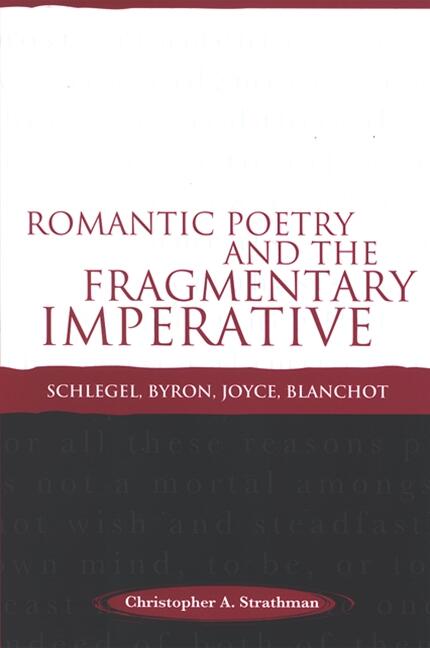
Romantic Poetry and the Fragmentary Imperative
Schlegel, Byron, Joyce, Blanchot
Romantic Poetry and the Fragmentary Imperative
Click on image to enlarge


Search this Book's Content
Christopher A. Strathman - Author
Price: $60.00 
Hardcover - 216 pages
Release Date: November 2005
ISBN10: 0-7914-6457-1
ISBN13: 978-0-7914-6457-1

Quantity:  
Price: $21.95 
Paperback - 216 pages
Release Date: June 2006
ISBN10: 0-7914-6458-X
ISBN13: 978-0-7914-6458-8

Quantity:  

Summary Read First Chapter image missing

Uses the concept of the poetic fragment to draw connections between romantic poetry and modern literature and literary theory.

Romantic Poetry and the Fragmentary Imperative
locates Byron (and, to a lesser extent, Joyce) within a genealogy of romantic poetry understood not so much as imaginative self-expression or ideological case study but rather as what the German romantics call "romantische poesie"—an experimental form of poetry loosely based on the fragmentary flexibility and acute critical self-consciousness of Socratic dialogue. The book is therefore less an attempt to present yet another theory of romanticism than it is an effort to recover a more precise sense of the relationship between Byron's fragmentary or "workless" poetic and romantic poetry generally, and to articulate connections between romantic poetry and modern literature and literary theory. The book also argues that the "exigency" or "imperative" of the fragmentary works of Schlegel, Byron, Joyce, and Blanchot is not so much the expression of a style as it is an acknowledgment of what remains unthought in thinking.

“…a sophisticated study and informed study of both the theory and practice of the Romantic fragment, as formulated in Germany by Friedrich Schlegel … From the range of reference alone in this [book], Romantic Poetry and the Fragmentary Imperative is an ambitious and capacious study of Romanticism that illuminates the ongoing and inextricable relation between literature and philosophy.” — The Wordsworth Circle

"Illuminating and even exhilarating to read, this book makes a powerful case for the contention that from Schlegel through Byron and Nietzsche to Joyce and Richard Rorty, the ironic strain of German romanticism—German romantic irony, one might say—has a continually liberating effect on philosophy, literary theory, and literature itself." — James A. W. Heffernan, author of Museum of Words: The Poetics of Ekphrasis from Homer to Ashbery

"Strathman offers a significant new perspective on the relationships between philosophy and literature, through his discussions of Byron and Joyce. He further (and productively) expands the book's scope by establishing connections to ordinary language philosophy, most specifically the work of Stanley Cavell. These features distinguish the book from other work in the field and give it a special appeal, especially in the author's readings of literary works. In particular the book offers one of the most compelling readings of Byron's Don Juan in recent years." — Arkady Plotnitsky, coeditor of Idealism without Absolutes: Philosophy and Romantic Culture

Christopher A. Strathman is Assistant Professor of English at Baylor University.


Table of Contents

Acknowledgments

1. Setting Out: Toward Irony, the Fragment, and the Fragmentary Work

2. Rethinking Romantic Poetry: Schlegel, the Genre of Dialogue, and the Poetics of the Fragment

3. Nothing so Difficult as a Beginning: Byron’s Pilgrimage to the Origin of the Work of Art and the Inspiration of Exile

4. Narrative and Its Discontents; or, The Novel as Fragmentary Work: Joyce at the Limits of Romantic Poetry

5. From the Fragmentary Work to the Fragmentary Imperative: Blanchot and the Quest for Passage to the Outside

Notes
Index


Related Subjects
44026/43986(JP/JB/AV)

Related Products

Reading Oprah
Reading Oprah
Through the Reading Glass
Jamaica Kincaid
Jamaica Kincaid
Kurt Vonnegut's Crusade; or, How a Postmodern Harlequin Preached a New Kind of Humanism
William Cullen Bryant


Customers Who Bought This Product Also Bought
Romantic Science
Romantic Science
The Modern Subject
The Modern Subject
The Death of Empedocles
The Philosophical Foundations of Early German Romanticism
Notes for a Romantic Encyclopaedia
 
bottom_1_963_35.jpg