|
Sees a way out of the contentious debates over the role of religion in American public life by looking back to the ideas of John Locke and the nation's Founders.
"I would rank this book as one of the best to come out in recent years in addressing the religious/secular dimensions of the American socio-political order." Derek H. Davis, Journal of Church and State
"This nation badly needs the balanced, responsible analysis of the proper role of religion in our society that is offered in this book. Acceptance of 'America's Sacred Ground' by all parties can provide the basis for civil discourse and moving ahead into new grounds." John B. Cobb Jr., Founding Co-Director of the Center for Process Studies and Professor Emeritus, Claremont School of Theology and Claremont Graduate School
"[An] important book. … Recommended." CHOICE
"[A] worthy-of-attention … argument designed to help change the circumstances of public discourse." Martin Marty, Sightings, Martin Marty Center at the University of Chicago Divinity School
"In a field strewn with ideological jeremiads, McGraw offers a nuanced interpretation of the public role of religion that respects both the potential contribution of religion to political dialogues and the dangers of imposing doctrine by fiat. I strongly recommend Rediscovering America's Sacred Ground." Kenneth D. Wald, Professor of Political Science, University of Florida and author of Religion and Politics in the United States, Fourth Edition
"In these difficult and frightening times, McGraw argues convincingly that the usual labeling of the 'religious right and the secular left' is simply wrong. For public discussion of religion to be safe, all parties must consent to a framework that encourages persuasion and rejects legal imposition of private values onto the entire population. McGraw argues persuasively that such a vision originally empowered the American republic and that it is of utmost importance to rediscover that 'sacred ground' now." Rita M. Gross, Professor Emerita of Comparative Studies in Religion, University of WisconsinEau Claire and author of Buddhism After Patriarchy: A Feminist History, Analysis, and Reconstruction of Buddhism
"McGraw's voice is articulate and strong, challenging the reader to consider the commonalities often unnoticed between the right and left in the United States. … [H]er book should serve as an essential resource for those seeking to understand the culture wars and make sense of the current American religio-political landscape." Political Science Quarterly
"McGraw argues convincingly throughout this work that America does not necessarily have a faith or a God but instead simply faith and God: 'the faith of all people who seek truth and goodness under a system of government that preserves to all the equal freedom to answer when God, however known or understood, calls.' … [She] makes clear … that the fundamental sacredness for one and all is the principle of freedom of conscience upon which all viable debate and individual search for the good rest. … Rediscovering America's Sacred Ground could not be more wholeheartedly recommended." Michael York, The Pomegranate
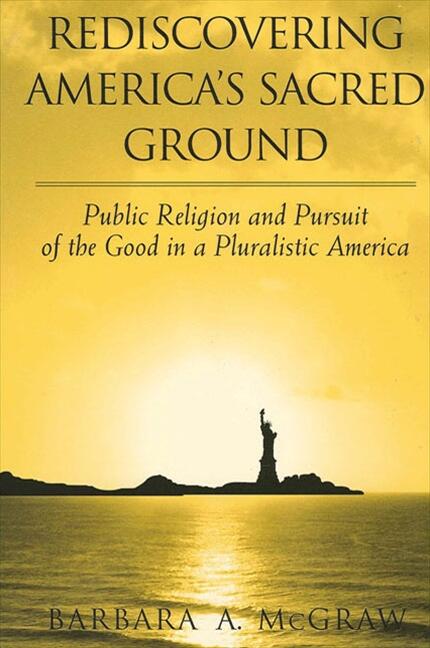
Returning to the ideas of John Locke and the Founders themselves, Barbara A. McGraw examines the debate about the role of religion in American public life and unravels the confounded rhetoric on all sides. She reveals that no group has been standing on proper ground and that all sides have misused terminology (religion/secular), dichotomies (public/private), and concepts (separation of church and state) in ways that have little relevance to the original intentions of the Founders. She rediscovers a theology underlying the founding documents of the nation that is neither anyone's particular religion nor one requiring religion. Instead, it justifies freedom of conscience for all and provides a two-tiered public foruma civic public forum and a conscientious public forumfor the debate itself and the actions that debate inspires. America's Sacred Groundthis theology and its public forumdetermines the meaning of freedom and the ways in which Americans can pursue "the good": good government, good communities, good families, good relations between individuals, and good individuals from a plurality of perspectives. By exploring our past, McGraw answers the critical question, Who are we as a people and what do we stand for?
"This is a significant contribution to our public life that points beyond the current impasse between the religious right and the secular left. A most exciting work." Mary Doak, University of Notre Dame
"Barbara McGraw brilliantly and convincingly argues that the Framers of the U.S. Constitution believed they were designing a government that could put into practice the ideals announced in the Declaration of Independence. These ideals, in their minds, existed before the design; they are the 'religion' behind the Constitution. Persons who argue for a 'living' Constitution have it right, therefore, and dissenters (including some on the current U.S. Supreme Court) have it wrong. All students of constitutional law reading McGraw's book will learn why." Phillip E. Hammond, author of With Liberty for All: Freedom of Religion in the United States
Barbara A. McGraw is Associate Professor of Legal, Ethical, and Social Environment at Saint Mary's College of California and the coauthor (with Robert S. Ellwood) of Many Peoples, Many Faiths: Women and Men in the World Religions, Seventh Edition.
|