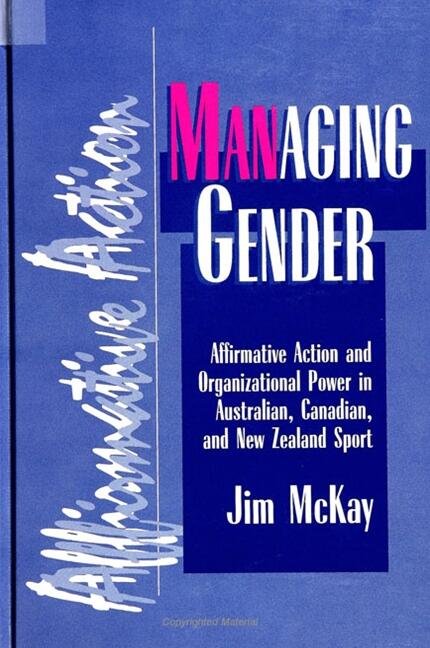
Managing Gender
Affirmative Action and Organizational Power in Australian, Canadian, and New Zealand Sport
Alternative formats available from:
Evaluates the implementation of affirmative action programs for women in Australian, Canadian, and New Zealand sporting organizations.
Description
This analysis of gender, sexuality, and power in sport evaluates how affirmative action programs for women have been implemented in sporting organizations in Australia, Canada, and New Zealand. Based on in-depth interviews with over one hundred men and women managers and supported by colorful examples from the popular press, Managing Gender shows that affirmative action initiatives usually have been marginalized, trivialized, or incorporated into the corporate-managerial and masculinist cultures that pervade sporting organizations, the media, and the state.
Jim McKay is Senior Lecturer in the Department of Anthropology and Sociology at the University of Queensland, Australia. He is the editor-in-chief of the International Review for the Sociology of Sport, and author of No Pain, No Gain? Sport and Australian Culture.
Reviews
"The book has tremendous breadth and is theoretically bold … Its relevance and significance for affirmative action studies on race and gender relations in organizations within and outside the United States is profound. " — Gender & Society
"Managing Gender will add significantly to the ever-increasing literature in the area of 'gender and sport,' most of which emanates from the United States and, therefore, focuses primarily on American culture. It will be a valuable addition as well to the sport management and organizational analysis literature that has not paid serious enough attention to gender or to the increasing scholarship on feminist organizations and feminist theoretical discussions of organizational analysis theory. " — Ann Hall, author of Feminism and Sporting Bodies: Essays on Theory and Practice
"McKay is probably the most visible and significant scholar doing this kind of work in Australia today. He builds a case for a sociological analysis of sports as a gendered institution by looking at different sites of its organization and deployment. McKay's analysis is sharp and the stories interesting. " — Michael Kimmel, State University of New York at Stony Brook
"This book provides a useful and timely example of the ways in which legislated equity initiatives can be resisted, subverted, and coopted not only by those whose power and privilege are threatened (in this case, most men) but also by some women. The extensive excerpts from the interviews provide graphic evidence of the extent of the problem. " — Helen Jefferson Lenskyj, University of Toronto, author of Out of Bounds: Women, Sport and Sexuality and Women, Sport and Physical Activity